
New Book Explores the Impact of AI-Driven Mass Unemployment and What Governments May Do to Solve It


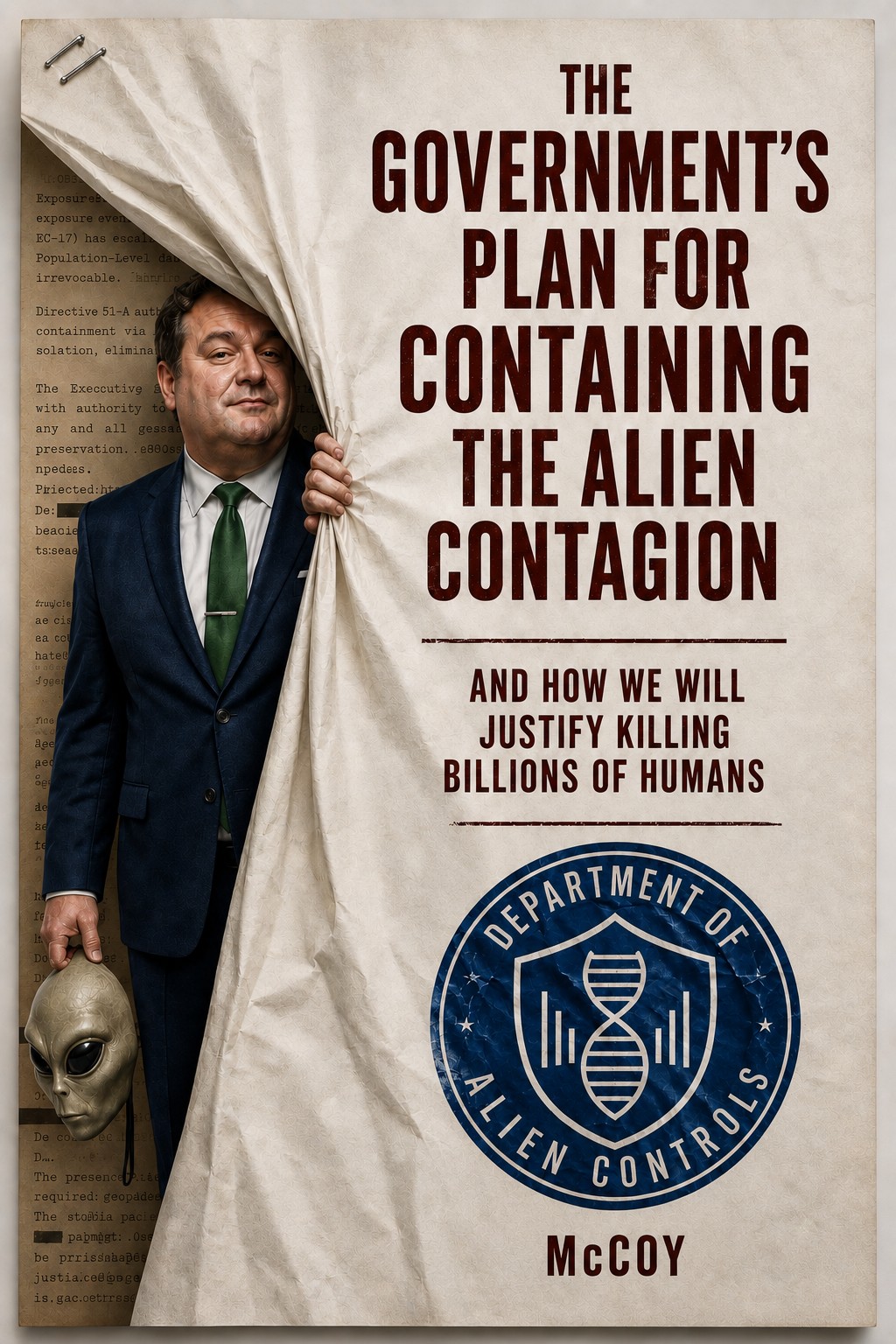
New release argues that future planning is critically incomplete unless it accounts for AI-induced overpopulation, the political instability it may create, and the emergency measures governments could use to retain control.
(YorkPedia Editorial):- Nashville, Tennessee Aug 10, 2026 (Issuewire.com) – What will governments do when artificial intelligence no longer merely transforms work but makes a substantial share of the population economically unnecessary? That is the question at the center of the new book, The Government’s Plan for Containing the Alien Contagion, and How We Will Justify Killing Billions of Humans.
The book is aimed at anyone trying to anticipate the future: business leaders, policymakers, futurists, pastors, investors, parents, researchers, technology professionals, and citizens who recognize that a plan built without considering AI-driven employment disruption is a critically flawed plan. Its central premise is direct: if AI displaces enough workers quickly enough, governments will confront a massive population that remains expensive to support, difficult to employ, politically volatile, and impossible to ignore.
The author, a West Point-trained strategist, applies criteria-based planning to the problem. Instead of asking only whether AI will eliminate jobs, the book asks what governments will do when the economic and political consequences become too large for conventional welfare systems, labor-market programs, or public reassurance to contain. The book’s scenario does not present an alien encounter as mere science fiction. It examines how such an event could supply the moral, legal, biological, and emotional justification for extreme government action against a population newly defined as both economically burdensome and biologically dangerous.
What Happens When AI Makes Human Labor Less Necessary?
Most public discussion about AI centers on productivity, innovation, investment, fraud, privacy, and individual job displacement. Those subjects matter, but they do not fully address the strategic question raised in the book: what happens when AI and automation eliminate enough productive roles that millions of people become permanently dependent on systems that no longer need their labor?
The author frames this as a problem of governance rather than simply a problem of technology. In the book’s scenario, advanced AI changes the logic of modern political and economic systems by weakening the historic relationship among employment, income, tax revenue, social participation, and public order. The scenario asks readers to consider what happens when governments face a population they must still feed, house, monitor, and manage–but for whom they can identify no durable productive role or financially sustainable support model.
The result, the book argues, is a future planning problem that cannot be responsibly dismissed. A government may be able to absorb limited unemployment, retrain some workers, or offer temporary aid. But when displacement becomes structural rather than cyclical, the pressure expands beyond budgets. It reaches public confidence, social cohesion, electoral stability, crime, migration, family formation, housing, health systems, and the legitimacy of the institutions responsible for maintaining order.
Any future plan that ignores that possibility–whether it is a corporate strategy, a public-policy forecast, a church preparedness program, or a family financial plan–may be preparing for a world that no longer exists.
Why Is AI-Induced Overpopulation a Future-Planning Issue?
The book’s core argument is that AI-induced overpopulation must be treated as an approaching macro trend. It uses the phrase to describe a future in which a growing number of people are no longer required by the productive economy but remain fully present in society, with needs, political claims, and the capacity to resist systems that marginalize them.
This is not a prediction that every displaced worker will become permanently unemployable, nor a claim that technology automatically requires coercion. It is a strategic warning about incentives. When governments cannot identify practical ways to support a large dependent population indefinitely, they face choices that become progressively more severe under fiscal stress, political unrest, and emergency conditions.
The book challenges readers to stop treating AI as a narrow technology story. It is also a demographics story, a governance story, a security story, a moral story, and a story about which human beings continue to be regarded as valuable when their market value declines. The consequences will affect every institution attempting to make long-range decisions.
How Can Historical Macro Trends Reveal Future Government Plans?
The author’s approach is grounded in criteria-based strategy planning: identify the problem a decision-maker believes must be solved, identify the constraints that limit available options, and assess which future course of action best satisfies the decision-maker’s requirements. This is not an exercise in predicting exact dates or claiming secret knowledge. It is an examination of how institutions behave when they feel compelled to protect power, preserve order, reduce costs, and control public reaction.
The book connects current AI disruption to historical macro trends in emergency government: concentrated executive authority, restrictions on movement and assembly, information control, status classifications, surveillance expansion, public-health rationales, and the tendency to frame extraordinary measures as temporary necessities. According to the author, its scenarios are extrapolated from documented patterns in public-health emergencies, national-security crises, covert experimentation, and church-state conflict–not offered as certainty about a single inevitable future.
This perspective makes the book relevant to readers beyond the UFO or alien-contact audience. It is written for anyone who wants to understand the arc from the past, through the present, and into future government decision-making. It asks a difficult but necessary question: if institutions historically expand their authority during crisis, what kind of crisis would give them the widest possible authority to solve an AI-driven population problem?
Why Would an Alien Encounter Change Government Policy?
The book’s answer is that an alien encounter could function as the catalyst for a pre-built control architecture. Governments cannot openly present depopulation as labor policy, budget reform, or a solution to dependency. A politically viable program of extraordinary control would require a crisis larger than ordinary politics–one that combines fear, biological risk, national security, scientific uncertainty, and public demand for decisive leadership.
In the book’s alien-contagion scenario, first contact is not framed as a curiosity in the sky. It is framed as an unprecedented biosecurity emergency involving alleged non-human biologics, genetic anomalies, unexplained illnesses, and the possibility of contamination. That framing allows authorities to argue that normal debate must yield to emergency action. ChristiansAndAliens.com describes this hypothetical alien event as the “ignition key,” rather than the origin, of a system that could use classification, surveillance, quarantine, and public persuasion to convert extraordinary policies into perceived medical or patriotic necessity.
The point is not that every alien report is a government plan. The point is that future planners should understand how a sufficiently powerful emergency narrative could reorganize law, public opinion, religion, technology, and human rights in a remarkably short period.
What Does the Book Reveal About Emergency Control?
Rather than relying on general commentary, The Government’s Plan for Containing the Alien Contagion presents its case through detailed, internal-style documents designed to read like an archive from a future emergency state. The book includes the Alien Biosecurity Act, Executive Orders 1-10, the Department of Alien Controls Charter and Mission Brief, and the End-of-Life Eligibility Review Packet.
Together, these documents trace the movement from legal authority to operational control: emergency declarations, mandatory registration, quarantine systems, restrictions on worship and assembly, contractor mobilization, data integration, surveillance, messaging, and the bureaucratic reframing of life-and-death decisions. The scenario is deliberately disturbing because it demonstrates how language, forms, procedural reviews, and official euphemisms can make policies appear administrative long before the public confronts their human consequences.
Who Should Read This Book?
This is a book for readers who want to see beyond daily headlines and evaluate the macro trends shaping the next era of public policy and social control. It will interest AI researchers, futurists, preparedness professionals, economists, political analysts, theologians, civil-liberties advocates, business leaders, and anyone asking what institutions will do when advanced automation disrupts the basis of social stability.
It is also a challenge to churches, families, and local leaders. If future emergencies place new pressure on conscience, worship, family autonomy, bodily integrity, and human dignity, then preparedness must include more than supplies or financial planning. It must include moral clarity, historical awareness, and the ability to recognize when fear is being used to make once-unthinkable actions appear reasonable.
The Government’s Plan for Containing the Alien Contagion, and How We Will Justify Killing Billions of Humans is now available from Christians and Aliens. Explore the project’s scenarios and future-facing analysis at ChristiansAndAliens.com.
Disclaimer: The book presents a fictional and speculative scenario. Its events, documents, government programs, alien encounter, organizations, and emergency measures are not presented as evidence of real-world plans or operations.
This article was originally published by IssueWire. Read the original article here.
